
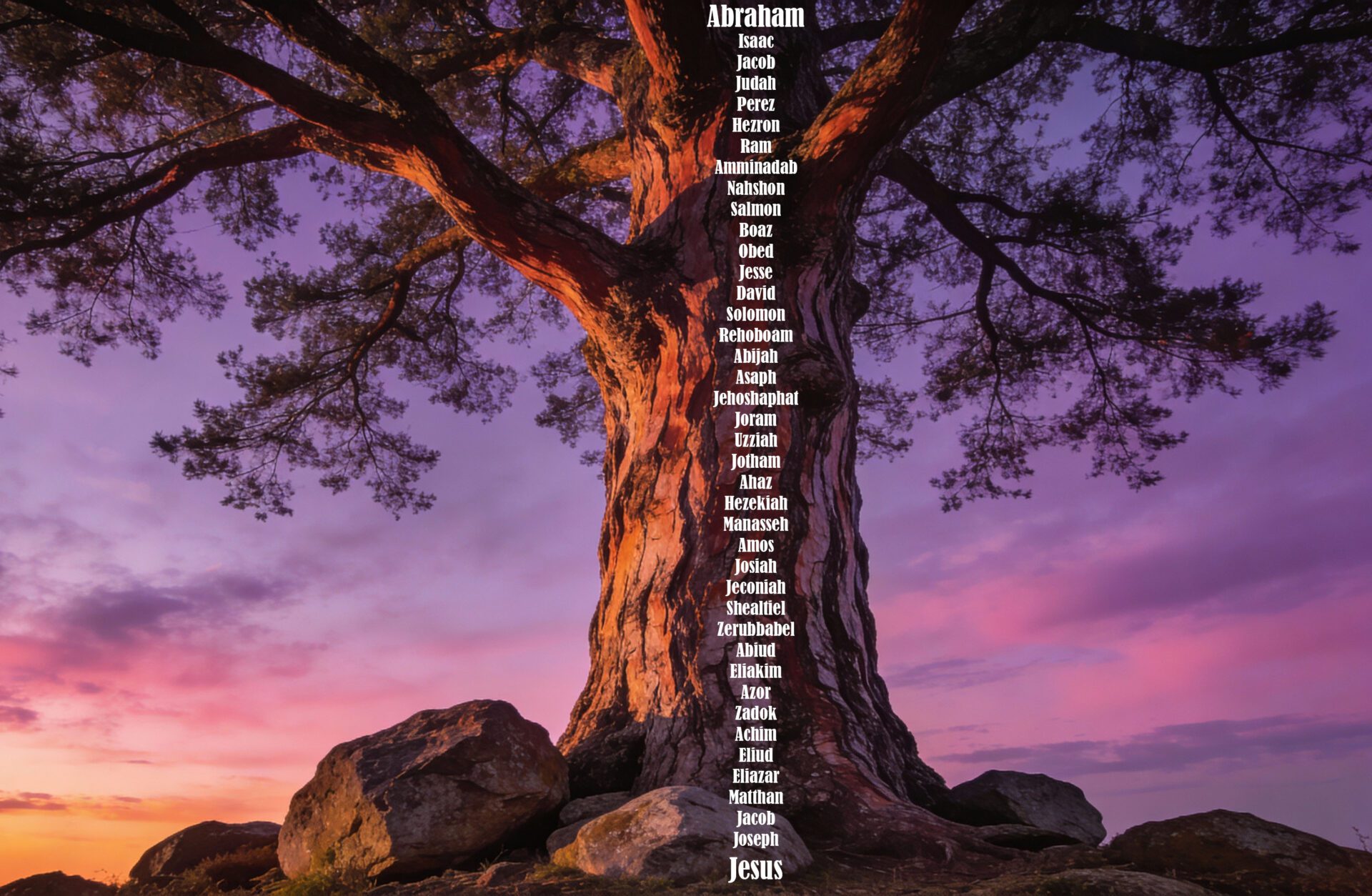

“The book of the genealogy of Jesus Christ, the son of David, the son of Abraham,” (Matthew 1:1).
Over the years, I have shared my personal story of how I came to know Jesus the Messiah. When my brother had a powerful encounter with the Lord, who called him by grace, he was immediately delivered from drug addiction and started sharing the Gospel with me. Not only did I hear the Gospel from his lips. But, when I saw him, I understood what the apostle Paul meant when he said, “Therefore, if anyone is in Christ, he is a new creation. The old has passed away; behold, the new has come,” (II Corinthians 5:17).
But even after seeing and hearing these things, I remained resistant to the Gospel. Some months after my brother came to faith, I ran away from home and was picked up by three believers who offered to feed me and gave me a warm bed. After sharing a meal, they spent many hours that night rehearsing the love of God in the Messiah Jesus. What they shared, I had heard before from the lips of my brother. But it was the love of God towards me, emanating from strangers, that captivated my heart that night.
In the morning, they took me to the bus station and bought me a ticket to my final destination. As I was boarding the bus, one of the men handed me a pocket New Testament. I had never read the New Testament nor had I ever held it in my hand. As a Jew, I had all of the common presuppositions most Jews have, that the New Testament is the most Gentile book ever written. I struggled with whether or not to open it, but curiosity got the best of me, and I reached into my coat pocket where I had stuffed it and read these words which open the New Testament:
“The book of the genealogy of Jesus Christ; the Son of David, the Son of Abraham,” (Matthew 1:1).
My mind was totally blown—it was so Jewish! As I reread these words, I realized that the first two guys, Abraham and David, lie at the heart of the covenant that God made with the nation of Israel. That covenant was the promise that through them (Abraham and David), God promised to send the Messiah to the people of Israel. This is clearly seen through the genealogy that opens the Gospel of Matthew. It begins with the man Abraham to whom the promise was made that “in him all the families of the earth shall be blessed” (Genesis 12:3). Even before God made this promise to Abraham, it was clear that God was setting apart one family in the earth for some special purpose. Look at the genealogy in Genesis chapter 5, and it is clear that God is setting apart one family among the families of the earth. For example, in chapter 4, verses 17-24, there is a record of the family of Cain. But it differs from Seth’s genealogy in that it is a mere list of descendants with no genealogical information. When it comes to Seth’s genealogy (5:1-32), it has the genealogical information that is necessary for keeping a record to preserve a family line. The same is true of Shem’s genealogy found in Genesis 11:1-26.
The next name in Matthew’s opening is David (Matthew 1:1). The promise of Messiah was that He would come through King David. For that reason, there is more historical information regarding David than any other person throughout the Old Testament. Messiah himself would be “ben David” (Son of David). And not only that, there would not be lacking one man from sitting upon the throne of David (Psalm 89). The rest of the genealogy in Matthew chapter one is a family line of Jesus beginning with the patriarch Abraham through David. It ends at the exile to Babylon:
And after the deportation to Babylon: Jechoniah was
the father of Shealtiel, and Shealtiel the father of
Zerubbabel, and Zerubbabel the father of Abiud, and
Abiud the father of Eliakim, and Eliakim the father of
Azor, and Azor the father of Zadok, and Zadok the
father of Achim, and Achim the father of Eliud,
and Eliud the father of Eleazar, and Eleazar the father
of Matthan, and Matthan the father of Jacob, and Jacob
the father of Joseph the husband of Mary, of whom
Jesus was born, who is called Christ.
Matthew 1:12-16
The genealogy is grouped into three sets of fourteen generations: from Abraham to David, from David to the exile, and from the exile to the Messiah. This compressed pattern retells Israel’s story—the rise under David, the decline into exile, and awaited restoration—so that Jesus appears at the climax and fulfillment of one story and the author of a new story and new age to come.


0 Comments